A Technical Project Manager is a professional who oversees technology-driven projects by blending project management skills with a solid technical background. They are responsible for managing project teams, communicating with stakeholders, and using their technical knowledge to guide the project toward successful completion.
They often have knowledge of software development lifecycles (SDLC), Agile or Scrum methodologies, cloud platforms (like AWS or Azure), system architecture, APIs, DevOps practices, and common tools like JIRA, Git, or Confluence. This technical expertise helps them communicate better with developers, solve problems faster, and make smarter decisions during the project lifecycle.
Preparing for a Technical Project Manager interview is crucial, as it equips candidates with the insights and confidence needed to navigate the interview process effectively. Here, we are sharing a variety of popular interview questions and answers, ranging from those suitable for freshers to experienced candidates, including technical, real-life scenario-based questions that will help you prepare better for the interview. We are also providing a PDF download for offline preparation.
Table of Contents
Technical Project Manager Interview Questions and Answers for Fresher
For the very first, we are going to share basic data analyst interview questions and answers for freshers. These fundamental questions will cover essential knowledge about the data analyst role, focusing on data analysis, data visualization, and data cleaning techniques.
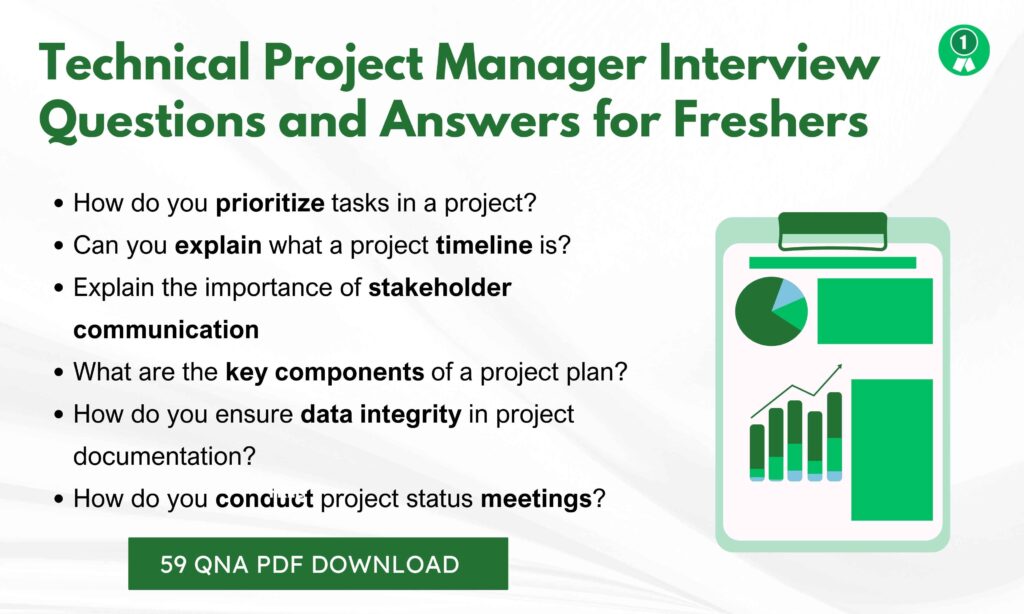
1. What is the role of a Junior Technical Project Manager?
A Junior Technical Project Manager assists in planning, executing, and closing projects while ensuring that they align with company goals. They help coordinate team efforts and communicate with stakeholders.
2. Can you explain what a project timeline is?
A project timeline is a visual representation that outlines the schedule of tasks in a project. It helps track progress and ensures that deadlines are met.
3. What tools do you use for project management?
Common tools include Trello, Asana, Microsoft Project, and JIRA. These tools help in tracking tasks, deadlines, and team collaboration.
4. How do you prioritize tasks in a project?
Tasks can be prioritized based on their urgency and importance, often using a priority matrix or by consulting with team members and stakeholders.
5. What is a Gantt chart, and how do you use it?
A Gantt chart is a type of bar chart that represents a project schedule. It displays tasks along a timeline and is used to track progress and dependencies.
6. Explain the importance of stakeholder communication.
Effective communication with stakeholders ensures that everyone is aligned with project goals, expectations, and progress, which helps in minimizing risks and misunderstandings.
7. How do you handle project scope changes?
Handling scope changes involves assessing the impact on time and resources, communicating with stakeholders, and formally documenting the change request for approval.
8. What are the key components of a project plan?
| Component | Description |
|---|---|
| Project Scope | Defines project objectives, deliverables, and boundaries |
| Timeline/Schedule | Outlines key milestones, tasks, and deadlines |
| Resources | Identifies required personnel, tools, and materials |
| Budget | Estimates the total cost and allocates funds accordingly |
| Risk Management | Identifies potential risks and plans mitigation strategies |
| Communication Plan | Details how and when information will be shared with stakeholders |
| Quality Management | Defines quality standards and how they will be achieved and measured |
| Stakeholder Management | Lists stakeholders and strategies for engagement and involvement |
9. Describe a time when you faced a project challenge.
In a previous project, we faced a tight deadline due to unforeseen issues. By reallocating resources and increasing team meetings, we overcame the challenge and delivered on time.
10. How do you ensure data integrity in project documentation?
Ensuring data integrity involves regular reviews, using version control systems, and maintaining clear documentation standards to avoid errors and miscommunication.
11. What is the purpose of a project kickoff meeting?
A project kickoff meeting sets the stage for the project, aligning the team on objectives, roles, and expectations, and fostering collaboration from the outset.
12. How do you measure project success?
Project success can be measured through criteria such as meeting project objectives, adhering to budget and timeline, and stakeholder satisfaction.
13. What is risk management in project management?
Risk management involves identifying, analyzing, and responding to potential risks that could impact project success. It includes creating mitigation strategies.
14. Explain the concept of Agile project management.
Agile project management focuses on iterative development, allowing teams to respond to change quickly and deliver small, incremental improvements throughout the project lifecycle.
15. How do you conduct project status meetings?
Status meetings should have a clear agenda, focusing on progress updates, roadblocks, and next steps. Encouraging open communication fosters team collaboration.
16. What is the difference between qualitative and quantitative data in project management?
Qualitative data relates to subjective assessments and descriptions, while quantitative data involves numerical measurements and statistics. Both types are important for informed decision-making.
17. How do you handle conflicts within a project team?
Conflicts should be addressed openly and respectfully, allowing team members to share their perspectives. Mediation and finding common ground can help resolve issues.
18. What techniques do you use for effective data analysis in project management?
Techniques include data visualization tools, such as charts and graphs, and statistical analysis to derive insights from project data, ensuring informed decision-making.
19. How do you ensure effective data cleaning for project reports?
Data cleaning involves identifying and correcting inaccuracies in project data, such as duplications or incomplete entries, ensuring that reports reflect reliable information.
20. What are the common data analysis tools you use in project management?
Common tools include Microsoft Excel for data manipulation, Tableau for data visualization, and specialized project management software that provides analytics features.
Also Check: Project Manager Interview Questions for Freshers
Also Check: Technical Interview Questions and Answers
Senior Technical Project Manager Interview Questions and Answers for Experience
We have covered basic questions. Now we will share senior-level technical project manager interview questions and answers for experienced roles.
1. How do you prioritize tasks in a technical project with tight deadlines?
Answer:
I prioritize tasks based on business impact, critical path dependencies, and resource availability. I use tools like RICE (Reach, Impact, Confidence, Effort) or MoSCoW (Must-have, Should-have, Could-have, Won’t-have) for structured prioritization. I also involve tech leads and stakeholders in alignment discussions to ensure that business and technical priorities are in sync.
2. What’s your experience with Agile or Scrum in managing technical teams?
Answer:
I have led multiple Agile teams using Scrum methodology, including sprint planning, daily stand-ups, backlog grooming, and retrospectives. I work closely with Product Owners to manage the backlog and ensure that development teams follow Agile best practices while still aligning with delivery timelines.
3. How do you manage cross-functional teams in a globally distributed environment?
Answer:
I establish clear communication protocols and use collaboration tools like Slack, Zoom, Jira, and Confluence. I ensure overlapping work hours for coordination, document everything clearly, and schedule regular sync-ups. Cultural awareness and trust-building are also key to keeping the team motivated and aligned.
4. Describe your approach to handling scope creep in technical projects.
Answer:
When scope creep arises, I first assess the impact on time, cost, and resources. I then document the change, consult stakeholders, and determine whether to accept, defer, or reject it. If accepted, I ensure change requests are officially tracked and communicate the updated scope to the team.
5. How do you resolve conflicts between engineering and business teams?
Answer:
I act as a mediator by listening to both sides and identifying root causes, often misaligned expectations or unclear priorities. I then facilitate a data-driven discussion to align on common goals and agree on trade-offs. Transparency and compromise are key to finding workable solutions.
6. What tools do you use for tracking project progress and risks?
Answer:
I use Jira for task and sprint management, Confluence for documentation, and Smartsheet or Microsoft Project for high-level timelines and Gantt charts. For risk management, I maintain a RAID log (Risks, Assumptions, Issues, Dependencies) and review it regularly during project check-ins.
7. How do you ensure technical debt doesn’t derail long-term project success?
Answer:
I work with tech leads to track technical debt in the backlog and prioritize it regularly. I also advocate for time in sprints specifically allocated to refactoring or upgrading outdated components. Communicating the long-term cost of tech debt to stakeholders helps gain buy-in for addressing it early.
8. What’s your approach to handling production incidents during a live project rollout?
Answer:
I follow a structured incident response process:
- Notify stakeholders and freeze any further deployments
- Initiate root cause analysis while logging all findings
- Collaborate with DevOps and engineering to restore services
- Communicate status updates to impacted users
- Conduct a post-incident review and document lessons learned
My priority is fast recovery without compromising data integrity or trust.
9. How do you handle estimation when requirements are still unclear?
Answer:
I use a high-level estimation technique like T-shirt sizing or story points with a buffer for uncertainty. I involve developers early to provide input based on past projects and risk factors. I clearly communicate that initial estimates are flexible and subject to refinement once discovery is complete.
10. Describe a technical decision you influenced as a project manager.
Answer:
In one project, developers were considering building a custom authentication system. I intervened and recommended using an existing identity management solution like Auth0 to save time, reduce security risk, and meet deadlines. After consulting with the security team, we adopted the SaaS solution, and it reduced dev time by 30%.
11. How do you manage integration dependencies across multiple teams?
Answer:
I map out interface points early in the project and establish shared API documentation and version control policies. I schedule frequent integration testing checkpoints and set deadlines for dependent teams. I also assign integration leads in each team to ensure accountability and coordination.
12. How do you ensure non-functional requirements (performance, scalability, security) are addressed?
Answer:
I integrate non-functional requirements into the project plan from day one. I work with architects and QA teams to define benchmarks, performance goals, and security requirements. I also ensure these are tracked as part of the acceptance criteria and validated through load testing, vulnerability scans, and code reviews.
13. How do you track and improve team performance over long-term projects?
Answer:
I track velocity, sprint burndown, and cycle time through analytics in Jira. I conduct regular retrospectives to gather feedback and remove blockers. I also schedule 1:1s to understand individual goals and challenges, offer mentorship, and align development paths with project needs.
14. How do you manage cloud-based infrastructure projects?
Answer:
I coordinate closely with DevOps and cloud architects to define infrastructure-as-code practices (using Terraform, CloudFormation), monitor provisioning, and plan for auto-scaling, backups, and failover. I ensure compliance with cloud security policies and track costs to stay within budget using tools like AWS Cost Explorer.
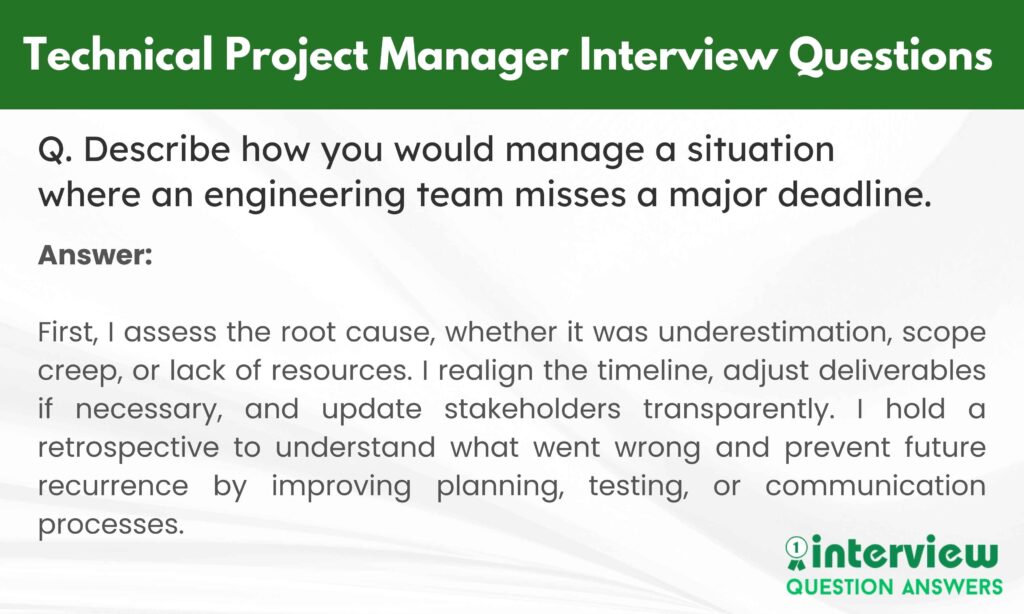
15. Describe how you would manage a situation where an engineering team misses a major deadline.
Answer:
First, I assess the root cause, whether it was underestimation, scope creep, or lack of resources. I realign the timeline, adjust deliverables if necessary, and update stakeholders transparently. I hold a retrospective to understand what went wrong and prevent future recurrence by improving planning, testing, or communication processes.
Software Technical Project Manager Interview Questions and Answers
1. How do you ensure alignment between product requirements and development execution?
Answer:
I work closely with product managers during the requirement gathering phase to clarify scope and acceptance criteria. Then, I translate these into user stories with the development team during sprint planning. Regular sprint reviews and backlog grooming sessions help ensure that development stays aligned with evolving product priorities.
2. What’s your approach to managing Agile software projects?
Answer:
I follow Agile principles by facilitating iterative development cycles, prioritizing customer feedback, and encouraging collaboration. I run daily stand-ups, maintain a refined backlog in Jira or Azure DevOps, and track sprint velocity. I also make sure retrospectives are action-oriented to continuously improve team processes.
3. How do you handle situations where developers and QA teams have conflicting timelines?
Answer:
I bring both teams together to understand their concerns and constraints. Often, conflicts stem from unclear expectations or lack of buffer time. I revisit the sprint goals, adjust priorities if needed, and ensure future sprints include better planning for testing and bug resolution cycles.
4. How do you manage feature delivery alongside fixing technical debt?
Answer:
I maintain a dual-track backlog that includes both features and technical debt. I ensure that each sprint includes a mix of both, with at least 10–20% of capacity reserved for addressing debt. This prevents long-term degradation of code quality while keeping business stakeholders satisfied.
5. Describe your experience working with CI/CD pipelines in software projects.
Answer:
I’ve collaborated with DevOps teams to integrate CI/CD using tools like Jenkins, GitHub Actions, and Azure Pipelines. I ensure pipelines support automated testing, code linting, and deployment to staging or production environments. I also coordinate rollback strategies and downtime communication during releases.
6. How do you track progress and manage scope across multiple software modules or microservices?
Answer:
I break down the project into feature modules, assign responsible teams or owners, and manage dependencies through a shared roadmap. I use Jira boards per module with cross-team sync meetings to ensure alignment. Dependencies are tracked visually using Gantt charts or roadmap tools like Aha! or Monday.com.
7. How do you manage risks related to third-party integrations in software projects?
Answer:
I evaluate third-party APIs or libraries during the planning phase by reviewing documentation, SLAs, and community feedback. I add fallback logic and retries in the architecture and keep test environments synced. I also track versioning, monitor downtime via status pages, and build abstraction layers to switch providers if needed.
8. What metrics do you use to evaluate software project health?
Answer:
Key metrics include:
- Sprint velocity and cycle time
- Code coverage from automated tests
- Defect leakage and severity trends
- Deployment frequency and lead time
- User acceptance feedback
These give a well-rounded view of both team performance and product stability.
9. How do you handle scope change in the middle of a software development sprint?
Answer:
If a scope change is critical, I assess its impact on current sprint commitments. I may swap out lower-priority tasks or move the new item to the next sprint after stakeholder alignment. If the change is significant, I consult the product owner and decide whether a mid-sprint adjustment is justified.
10. Can you explain how you’ve handled a failed software release and what steps you took afterward?
Answer:
After a failed release due to a missed bug in authentication logic, we rolled back immediately and initiated a hotfix. Post-incident, I organized a blameless retrospective to analyze gaps in our QA pipeline. We added new unit tests, updated our CI pipeline to include regression testing, and improved staging-to-production parity.
Common Technical Project Manager Interview Questions and Answers
1. How do you handle project deadlines when your team is falling behind?
Answer:
First, I assess the root cause—whether it’s resource constraints, scope creep, or estimation errors. I re-evaluate the project plan, re-prioritize tasks if needed, and communicate transparently with stakeholders about timeline adjustments. In some cases, I may reallocate resources, bring in temporary support, or adjust deliverables to keep the project moving forward.
2. How do you balance technical depth with project leadership in your role?
Answer:
While I don’t write production code, I stay technically informed to bridge the gap between engineers and stakeholders. I understand the tech stack, ask the right questions, and make decisions based on both technical feasibility and business value. This balance helps me earn the team’s trust while keeping the project aligned with business goals.
3. What’s your approach to stakeholder communication and expectation management?
Answer:
I maintain regular communication using status reports, dashboards, and sprint reviews. I align early on priorities, timelines, and deliverables, and set clear expectations about risks and limitations. When changes occur, I communicate promptly with options, impact analysis, and recommendations to help stakeholders make informed decisions.
4. How do you manage multiple projects with competing priorities?
Answer:
I use prioritization frameworks like MoSCoW or weighted scoring to align with business value. I maintain a centralized dashboard to track project health and dependencies. I schedule regular check-ins with leadership and adjust timelines or scope proactively based on resource availability and critical deadlines.
5. How do you identify and mitigate project risks?
Answer:
I conduct risk assessments at the planning stage and maintain a live RAID log (Risks, Assumptions, Issues, Dependencies). I categorize risks by impact and likelihood, assign owners, and define mitigation strategies. I also build buffer time into the schedule and revisit the risk register during weekly reviews.
6. How do you ensure that a technical project stays within scope and budget?
Answer:
I define detailed requirements up front with clear success criteria. I track actuals vs. forecast regularly using project management tools, and I monitor scope creep by enforcing change control processes. If changes arise, I update the cost and resource impact before getting approval from stakeholders.
7. What tools do you typically use for managing technical projects?
Answer:
I commonly use:
- Jira or Azure DevOps for Agile task management
- Confluence or Notion for documentation
- Smartsheet, Asana, or MS Project for planning
- Slack and Zoom for communication
- Power BI or Google Sheets for reporting and dashboards
8. How do you handle knowledge transfer and project handover?
Answer:
I schedule dedicated KT sessions, ensure documentation is updated and organized in a central repository, and involve both the outgoing and incoming teams in a phased handover plan. I also record walkthroughs and create SOPs to ensure long-term sustainability of the work delivered.
9. Can you describe a time you had to manage a team through a major technical change?
Answer:
During a cloud migration project, I led the team through shifting from on-prem infrastructure to AWS. I created a detailed change roadmap, coordinated training sessions, and ensured DevOps support during deployment. Regular feedback and gradual rollouts helped manage resistance and ensured a smooth transition.
10. What’s your strategy for aligning technical teams with business goals?
Answer:
I start by translating business objectives into measurable technical milestones. I involve engineers early in requirement discussions to give them context, which increases ownership. Throughout the project, I continuously link progress to business value in updates and retrospectives to keep everyone aligned and motivated.
Java Technical Project Manager Interview Questions and Answers
1. How do you manage a project built using Java technologies across multiple modules?
Answer:
I begin by working with architects and tech leads to define module boundaries, APIs, and dependencies. Each module is assigned to a sub-team with clear responsibilities. We use Maven or Gradle for dependency management and set up CI pipelines to ensure early integration. Regular sync-ups and documentation in Confluence help maintain cross-module alignment.
2. What tools and frameworks do you typically work with in Java-based projects?
Answer:
Most of my projects involve tools like:
- Spring Boot for backend development
- Hibernate or JPA for ORM
- PostgreSQL or MySQL for databases
- Maven or Gradle for build automation
- Jenkins, Git, and SonarQube for CI/CD and code quality
As a project manager, I don’t write code, but I stay familiar with these tools to understand team needs and make informed decisions.
3. How do you handle version control and branching strategies in Java enterprise projects?
Answer:
We follow Git Flow or trunk-based development, depending on the project size. For enterprise Java apps, Git Flow works well with feature branches, release branches, and hotfixes. I ensure all team members follow the same branching convention, and we conduct pull request reviews with CI integration to maintain quality.
4. How do you manage performance issues in Java applications during delivery?
Answer:
I involve the engineering team early to define SLAs and performance metrics. During development, we use tools like JProfiler, VisualVM, or New Relic to monitor JVM usage. We plan for load testing using JMeter and analyze memory leaks, thread usage, and GC logs to address bottlenecks before production rollout.
5. Describe a situation where you had to coordinate a Java microservices-based project.
Answer:
In a recent project using Spring Cloud and Netflix OSS stack, I managed multiple Java-based microservices that communicated via REST and Kafka. I ensured consistent API contracts using Swagger/OpenAPI, and we used Docker and Kubernetes for deployment. My focus was on coordinating deployments, versioning, service discovery, and maintaining CI/CD integrity across services.
6. How do you ensure Java-based backend systems stay scalable and maintainable?
Answer:
Scalability comes from early architectural planning—choosing stateless designs, using caching layers like Redis, and enabling horizontal scaling. Maintainability is ensured through clean code practices, unit testing with JUnit, consistent coding standards, and documentation. I also advocate for modular design and regular code refactoring based on team feedback and tech debt reviews.
7. What are the common challenges you face when managing large Java-based enterprise applications?
Answer:
Challenges include managing legacy codebases, handling tight integration with external systems, coordinating multi-team dependencies, and ensuring performance under load. I mitigate these by implementing automated testing, containerization, logging standards using tools like Logback + ELK stack, and organizing architecture review meetings regularly to address technical debt and scalability concerns.
More Java Questions Here: Java interview Questions and Answers
.Net Technical Project Manager Interview Questions and Answers
1. How do you manage a .NET-based project with both web and API components?
Answer:
I ensure a clear separation of responsibilities between the front-end (ASP.NET MVC or Razor Pages) and the API layer (ASP.NET Web API or Minimal APIs). I coordinate teams using layered architecture, shared documentation, and Swagger for API specs. CI/CD pipelines are configured to deploy web and API services independently through Azure DevOps.
2. What technologies and tools do you usually work with in .NET projects?
Answer:
Common tools include:
- Visual Studio or Rider for development
- ASP.NET Core for backend services
- Entity Framework Core for ORM
- SQL Server or Azure SQL for databases
- Azure DevOps, Octopus Deploy, and Git for CI/CD and version control
- Serilog or Application Insights for logging and monitoring
As a TPM, I stay updated on how these tools are used to manage infrastructure, track issues, and guide architectural decisions.
3. How do you ensure smooth deployment of .NET applications to cloud platforms?
Answer:
We use Azure DevOps for CI/CD pipelines and deploy to Azure App Services or AKS (Azure Kubernetes Service). I ensure proper staging environments are in place and implement deployment slots for zero-downtime releases. Pre-deployment checks and post-deployment health checks are automated to ensure quick rollback if needed.
4. How do you handle .NET version upgrades during a running project?
Answer:
I plan version upgrades in phases, starting with a technical impact assessment and dependency audit. We use feature flags to isolate changes and apply upgrades in isolated branches. I ensure the QA team performs regression testing and that automated test suites cover all critical paths before merging to main.
5. Describe how you’ve handled performance issues in a .NET backend application.
Answer:
In one project, API response times were lagging due to inefficient LINQ queries and excessive database joins. I worked with the dev team to optimize the queries, add caching via MemoryCache, and restructure the data access layer. We used Application Insights and SQL Profiler to monitor performance and identify bottlenecks.
6. How do you manage projects using microservices built in .NET Core?
Answer:
We use .NET Core Web APIs structured as independently deployable services, often containerized with Docker and orchestrated via Kubernetes. I manage service dependencies using Azure Service Bus or RabbitMQ, ensure API contracts are shared using Swagger, and maintain version control through Git branching strategies and CI pipelines for each microservice.
7. What are common challenges in large-scale .NET enterprise applications and how do you handle them?
Answer:
Challenges include tight coupling between modules, slow build times, and legacy .NET Framework components. I address these by promoting modular architecture (e.g., clean architecture), containerizing legacy components where needed, and migrating slowly to .NET 6 or later. Communication with stakeholders is key, especially when justifying refactoring or partial rewrites to ensure long-term maintainability.
Technical Project Manager Scenario-Based Interview Questions and Answers
1. A critical feature is behind schedule, and the client wants daily updates. How do you manage this situation?
Answer:
I would first meet with the development team to understand the cause of the delay and realign the delivery timeline. Then, I’d set up a short daily status call or summary email with the client to maintain transparency. I’d also share a revised project plan highlighting recovery actions and dependencies. Clear, proactive communication reduces pressure and maintains trust.
2. Two developers disagree on a technical solution. One wants to rewrite a module; the other prefers a quick fix. How do you resolve it?
Answer:
I facilitate a technical discussion focused on long-term maintainability, timelines, and business impact. I encourage both to present pros and cons, then involve a senior architect or tech lead if needed. My role is to balance time, cost, and quality—not to pick a side—so we choose the solution that meets delivery goals without compromising future stability.
3. Mid-project, the client introduces new requirements that impact architecture and timeline. What do you do?
Answer:
I conduct an impact analysis with the engineering team to evaluate technical and resource implications. Then, I present options to the client: (1) adjust the delivery timeline, (2) increase resources, or (3) phase the new requirements for a later release. I document the change and update the project scope accordingly using a formal change request process.
4. A production deployment fails late at night. What are your immediate steps?
Answer:
- Initiate the incident response plan
- Notify stakeholders and relevant teams
- Work with DevOps to assess rollback or hotfix options
- Set up a war room (or virtual equivalent)
- After resolution, conduct a post-mortem to identify root causes and corrective actions
I also ensure logs are captured, and documentation is updated to avoid recurrence.
5. Your QA team finds critical bugs just before the release date. How do you proceed?
Answer:
I assess the severity and risk of the bugs. If they are blocking core functionality, I recommend delaying the release and communicate the reasons transparently. If they’re minor or have workarounds, I discuss mitigation strategies with stakeholders. I also revise test coverage plans and sprint commitments to prevent last-minute surprises in future cycles.
6. Your development team is hitting burnout mid-way through a long project. What’s your approach?
Answer:
I immediately check workload distribution, recent sprint velocity, and overtime patterns. Then, I reassess the project plan to see where we can reduce scope, extend timelines, or bring in additional support. I also schedule informal team check-ins, encourage breaks, and ensure work-life balance is respected. A motivated team delivers better results long term.
7. During integration testing, a third-party API you rely on starts failing unpredictably. What do you do?
Answer:
I contact the API provider for updates and logs, then work with the dev team to build retry logic, fallbacks, or mock services to reduce impact. I also flag the issue in project risk reports and evaluate backup providers if downtime persists. Managing external dependencies means always having a Plan B ready.
Technical Project Manager Interview Questions Answers PDF
We’ve shared all types of questions, and now we’re adding a PDF download so you can prepare offline without distractions.
FAQs: Technical Project Manager interview
What is the role of a Technical Project Manager?
A Technical Project Manager is responsible for overseeing technical projects, ensuring that they are completed on time, within budget, and meet the required quality standards. They bridge the gap between technical teams and management, facilitating communication and ensuring that project goals align with business objectives.
What challenges might a Technical Project Manager face during their job?
Common challenges include managing complex data sets, ensuring data integrity, handling missing data, and navigating project scope changes. Additionally, they may face difficulties in communication with diverse teams and stakeholders, and in adhering to tight deadlines while maintaining data quality.
How can one prepare for a Technical Project Manager interview?
Preparation should include understanding the project management process, familiarity with data analysis tools, and having knowledge of data visualization and data analytics. Practicing answers to common interview questions and being ready to discuss past projects can also be beneficial.
What skills are essential for a Technical Project Manager?
Key skills include proficiency in data analysis, strong communication abilities, project management expertise, experience with data visualization tools, and the capability to analyze and manipulate large amounts of data. Knowledge of programming languages such as Python can also be advantageous.
What is the salary range for a Technical Project Manager in the USA?
The salary for a Technical Project Manager can vary widely based on experience, location, and the company. On average, salaries range from $80,000 to $130,000 per year, with top companies often paying higher rates due to the complexity of their projects.
Which companies are known for hiring Technical Project Managers?
Top companies that frequently hire Technical Project Managers include tech giants like Google, Amazon, Microsoft, and Facebook, along with consulting firms and financial institutions that require robust project management within technical teams.
What are some common interview questions for a Technical Project Manager?
While specific questions can vary, candidates should expect inquiries related to their experience managing technical projects, examples of how they have handled data-related challenges, and their approach to ensuring data accuracy and quality. Being prepared with relevant examples can greatly enhance the interview process.
Conclusion
This article provides a variety of Technical Project Manager interview questions and answers to help you get ready, regardless of your experience level. We cover questions suitable for beginners as well as advanced topics for those with more experience. You’ll find technical questions, scenario-based challenges, and project management issues related to Java, .NET, and specific software.
This guide helps you gain the knowledge needed to answer questions confidently in interviews for Technical Project Manager roles. We also offer a PDF download for offline preparation, so you can study anytime, even without internet access.
Use these questions not just to practice but to understand the skills and flexibility this role requires, helping you to enter your next interview fully prepared.