Cyber Security Analyst Interview Questions for Freshers 2025
Cyber Security Analyst Interview Questions for Freshers focus on fundamental security concepts, threat detection principles, and risk assessment techniques that entry-level and junior-level candidates must demonstrate. Breaking into cybersecurity requires mastering both theoretical knowledge and practical security tools that employers seek from new graduates entering this critical field.
This interview guide covers Cyber Security Analyst Interview Questions for Freshers seeking their first role in cybersecurity, addressing network security basics, incident response procedures, vulnerability assessment, and security compliance frameworks. These Entry Level Cyber Security Analyst Interview Questions will help you showcase your technical abilities, understanding of security protocols, and readiness to protect organizational assets in today’s threat landscape.
You can also check this: Cybersecurity Analyst Interview Questions And Answers PDF
Entry Level Cyber Security Analyst Interview Questions
Que 1. What is the role of a Cyber Security Analyst?
Answer: A Cyber Security Analyst protects an organization’s systems and data by monitoring for threats, analyzing vulnerabilities, and responding to incidents. Responsibilities include using tools like SIEM (e.g., Splunk), conducting risk assessments, and ensuring compliance with standards like GDPR. For freshers in 2025, understanding monitoring and basic incident response is key.
Que 2. What is the difference between a vulnerability, threat, and risk?
Answer:
| Term | Definition | Example |
|---|---|---|
| Vulnerability | Weakness in a system | Unpatched software |
| Threat | Potential danger exploiting a weakness | Malware attack |
| Risk | Likelihood and impact of a threat | Data breach due to weak passwords |
For freshers, distinguishing these helps in risk assessment tasks.
Que 3. What is a firewall, and how does it work?
Answer: A firewall is a network security device that filters incoming and outgoing traffic based on predefined rules. It blocks unauthorized access while allowing legitimate traffic, operating at the network or application layer. For freshers, understanding basic rules (e.g., allow/deny by IP) is essential.
Que 4. What is the CIA triad in cyber security?
Answer: The CIA triad stands for Confidentiality, Integrity, and Availability:
- Confidentiality: Protects data from unauthorized access (e.g., encryption).
- Integrity: Ensures data accuracy (e.g., hashing).
- Availability: Ensures systems are accessible (e.g., DDoS protection).
For freshers, it’s the foundation of security principles.
Que 5. What is a DDoS attack, and how can it be mitigated?
Answer: A Distributed Denial-of-Service (DDoS) attack floods a system with traffic to disrupt availability. Mitigation includes rate limiting, using CDNs like Cloudflare, and deploying intrusion detection systems. For freshers, recognizing signs (e.g., slow network) is critical.
Que 6. What is encryption, and why is it important?
Answer: Encryption converts data into an unreadable format using algorithms (e.g., AES) to protect confidentiality. It’s important for securing data in transit (e.g., HTTPS) and at rest. For freshers, knowing symmetric (AES) vs. asymmetric (RSA) encryption is key.
Que 7. What is a SIEM system, and how is it used in cyber security?
Answer: SIEM (Security Information and Event Management) systems collect and analyze logs to detect threats. Tools like Splunk or QRadar correlate events for real-time monitoring. For freshers, understanding log analysis in SIEM is a common task.
Example:
# Example Splunk query
search index=security sourcetype=access_log error
Que 8. What is the difference between IDS and IPS?
Answer:
| System | Function | Example |
|---|---|---|
| IDS | Detects and alerts on suspicious activity | Snort |
| IPS | Detects and blocks suspicious activity | Suricata |
IDS monitors; IPS actively prevents threats.
Que 9. What is a phishing attack, and how can it be prevented?
Answer: Phishing is a social engineering attack using fake emails or websites to steal credentials. Prevent with email filters, user training, and two-factor authentication (2FA). For freshers, recognizing phishing patterns is essential.
Que 10. What is a VPN, and how does it enhance security?
Answer: A Virtual Private Network (VPN) creates a secure, encrypted tunnel for data over public networks. It enhances security by protecting data in transit and masking IP addresses. For freshers, understanding VPN protocols like OpenVPN is useful.
Que 11. What is the purpose of a penetration test?
Answer: A penetration test simulates attacks to identify vulnerabilities in systems or networks. It helps assess security posture and prioritize fixes. For freshers, familiarity with tools like Metasploit is a starting point.
Que 12. What is a hash function, and how is it used in cyber security?
Answer: A hash function (e.g., SHA-256) generates a fixed-length string from data, used for integrity checks (e.g., verifying file downloads) or password storage. For freshers, understanding one-way properties is key.
Que 13. What is SQL injection, and how can it be prevented?
Answer: SQL injection exploits input vulnerabilities to manipulate database queries. Prevent with parameterized queries, input validation, and ORM tools like SQLAlchemy. For freshers, recognizing malicious inputs is critical.
Example:
# Safe query in Python
cursor.execute("SELECT * FROM users WHERE id = %s", (user_id,))
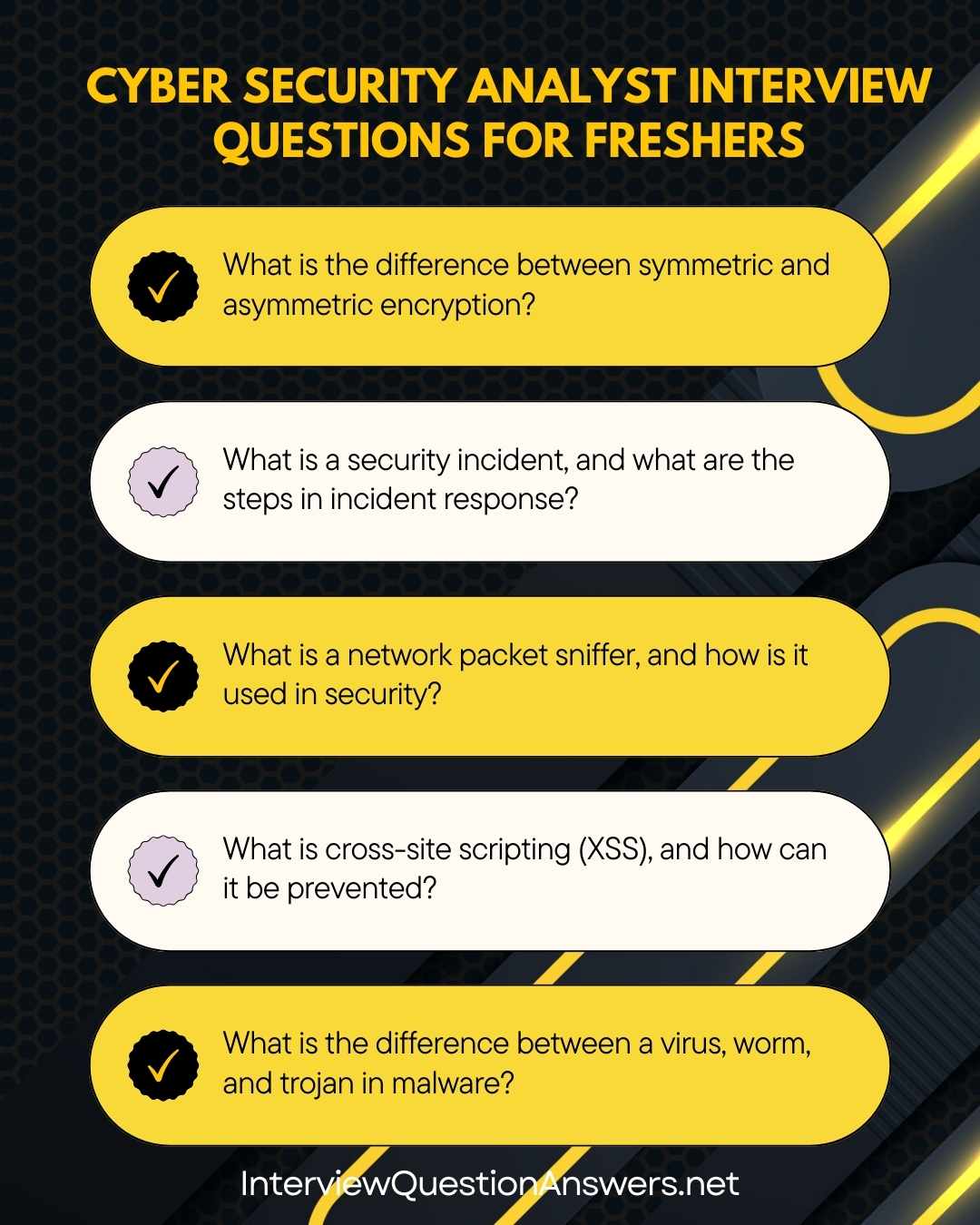
Que 14. What is the difference between symmetric and asymmetric encryption?
Answer:
| Type | Description | Example |
|---|---|---|
| Symmetric | Single key for encryption/decryption | AES |
| Asymmetric | Public/private key pair | RSA |
Symmetric is faster; asymmetric is secure for key exchange.
Que 15. What is a man-in-the-middle (MITM) attack?
Answer: MITM intercepts communication between two parties to steal data or manipulate messages. Prevent with HTTPS, TLS, and certificate pinning. For freshers, understanding secure protocols is essential.
Que 16. What is multi-factor authentication (MFA), and why is it important?
Answer: MFA requires multiple verification methods (e.g., password, OTP) to authenticate users, reducing unauthorized access risk. It’s critical for securing sensitive systems. For freshers, implementing MFA with tools like Auth0 is common.
Que 17. What is a security incident, and what are the steps in incident response?
Answer: A security incident is a breach or threat (e.g., malware). Steps: Preparation, Identification, Containment, Eradication, Recovery, Lessons Learned. For freshers, following NIST 800-61 guidelines is a good start.
Que 18. What is a brute force attack, and how can it be mitigated?
Answer: A brute force attack tries multiple password combinations to gain access. Mitigate with account lockouts, strong passwords, and CAPTCHA. For freshers, rate-limiting login attempts is a practical measure.
Que 19. What is the purpose of a security policy?
Answer: A security policy outlines rules and procedures to protect data and systems (e.g., password policies, access controls). It ensures compliance and consistency. For freshers, understanding policy enforcement is key.
Que 20. What is a network packet sniffer, and how is it used in security?
Answer: A packet sniffer (e.g., Wireshark) captures network traffic for analysis. In security, it’s used to detect suspicious activity or troubleshoot issues. For freshers, analyzing TCP/IP packets is a common task.
Que 21. What is the difference between authentication and authorization?
Answer:
| Term | Definition | Example |
|---|---|---|
| Authentication | Verifying identity | Username/password login |
| Authorization | Granting access to resources | Role-based access control (RBAC) |
Authentication confirms who; authorization defines what they can do.
Que 22. What is a vulnerability assessment, and how is it conducted?
Answer: A vulnerability assessment identifies weaknesses in systems using tools like Nessus or OpenVAS to scan for unpatched software or misconfigurations. For freshers, interpreting scan reports is a starting point.
Que 23. What is cross-site scripting (XSS), and how can it be prevented?
Answer: XSS injects malicious scripts into web pages viewed by users. Prevent with input sanitization, Content Security Policy (CSP), and escaping outputs. For freshers, using libraries like OWASP’s AntiSamy helps.
Que 24. What is the purpose of log analysis in cyber security?
Answer: Log analysis identifies threats or anomalies by reviewing system logs using tools like Splunk or ELK Stack. For freshers, writing basic queries to detect failed logins is a common task.
Que 25. What is a security patch, and why is it important?
Answer: A security patch fixes vulnerabilities in software or systems. It’s critical to apply patches promptly (e.g., via WSUS for Windows) to prevent exploitation. For freshers, monitoring patch cycles is a key responsibility.
Common Cyber Security Analyst Interview Questions for Freshers
Que 26. What is a zero-day vulnerability, and how can it be mitigated?
Answer: A zero-day vulnerability is a software flaw unknown to the vendor, exploited before a patch is available. Mitigation includes using intrusion detection systems (IDS) like Snort, deploying Web Application Firewalls (WAF), and maintaining updated threat intelligence feeds to detect unusual behavior. For freshers in 2025, understanding proactive monitoring with tools like CrowdStrike and applying least privilege principles are key to reducing exposure to such vulnerabilities.
Que 27. What is the difference between a virus, worm, and trojan in malware?
Answer:
| Malware Type | Description | Example |
|---|---|---|
| Virus | Attaches to legitimate files, spreads via user action | CodeRed |
| Worm | Self-replicates and spreads independently | WannaCry |
| Trojan | Disguises as legitimate software to trick users | Emotet |
For freshers, recognizing these distinctions aids in identifying and responding to specific threats using antivirus tools like Malwarebytes.
Que 28. How does a Security Operations Center (SOC) function, and what is a Cyber Security Analyst’s role in it?
Answer: A SOC monitors, detects, and responds to cyber threats in real-time using tools like SIEM (e.g., Splunk, QRadar). Analysts in a SOC analyze alerts, investigate incidents, and escalate issues. Their tasks include log analysis, threat hunting, and documenting incidents per frameworks like NIST 800-61. For freshers in 2025, familiarity with SOC workflows and basic alert triage is essential for entry-level roles.
Que 29. What is the purpose of a honeypot in cyber security?
Answer: A honeypot is a decoy system designed to attract attackers, allowing analysts to study their tactics and gather threat intelligence. It distracts from real assets and logs malicious activity. For freshers, setting up tools like Honeyd and analyzing logs for attack patterns are practical skills.
Que 30. What is two-factor authentication (2FA), and how does it differ from multi-factor authentication (MFA)?
Answer: 2FA requires two verification methods (e.g., password + SMS code). MFA extends to two or more methods, including biometrics or tokens. 2FA is a subset of MFA. For freshers in 2025, implementing MFA with tools like Google Authenticator enhances system security.
Que 31. What is a cross-site request forgery (CSRF) attack, and how can it be prevented?
Answer: CSRF tricks users into executing unwanted actions on a web application where they’re authenticated. Prevent with CSRF tokens, validating HTTP methods, and SameSite cookies. For freshers, using frameworks like Django with built-in CSRF protection is a common practice.
Example:
# Django CSRF token in HTML
<form method="POST">
    {% csrf_token %}
    <input type="submit" value="Submit">
</form>
Que 32. What is network segmentation, and why is it important?
Answer: Network segmentation divides a network into smaller zones to limit the spread of attacks and control access. It’s important for isolating sensitive systems and reducing attack surfaces. For freshers, understanding VLAN configuration and firewall rules for segmentation is key.
Que 33. What is the difference between black-box, white-box, and gray-box testing?
Answer:
| Testing Type | Knowledge Level | Example Use Case |
|---|---|---|
| Black-Box | No internal knowledge | External penetration testing |
| White-Box | Full access to code/system | Internal code audits |
| Gray-Box | Partial knowledge | Hybrid testing scenarios |
For freshers, assisting in black-box tests with tools like Burp Suite is common.
Que 34. How do you use Wireshark for network security analysis?
Answer: Wireshark captures and analyzes network packets to detect suspicious activity, such as unauthorized connections or malformed packets. For freshers in 2025, filtering packets (e.g., tcp.port == 80) and identifying anomalies like unusual IP traffic are standard tasks.
Example:
# Wireshark filter for HTTP traffic
tcp.port == 80
Que 35. What is a security misconfiguration, and how can it be prevented?
Answer: Security misconfiguration is improper setup of systems (e.g., default passwords, open ports). Prevent by following CIS benchmarks, automating configurations with Ansible, and scanning with tools like Nessus. For freshers, checking for open ports with Nmap is a practical skill.
Que 36. What is the role of intrusion detection systems (IDS) in network security?
Answer: IDS monitors network traffic for suspicious activity, generating alerts for potential threats. Types include signature-based (known patterns) and anomaly-based (deviations). For freshers, configuring tools like Snort and analyzing alerts is a common responsibility.
Que 37. What is a privilege escalation attack, and how can it be mitigated?
Answer: Privilege escalation grants attackers higher access levels (e.g., admin) by exploiting vulnerabilities. Mitigate with least privilege principles, regular patching, and monitoring for unusual activity. For freshers in 2025, auditing user permissions with tools like PowerBroker is key.
Que 38. What is the OWASP Top 10, and why is it important?
Answer: The OWASP Top 10 is a list of the most critical web application vulnerabilities (e.g., injection, broken authentication). It’s important for prioritizing security efforts and educating teams. For freshers, understanding vulnerabilities like XSS or SQL injection is essential.
Que 39. How do you analyze logs to detect security incidents?
Answer: Analyze logs using SIEM tools like Splunk or ELK Stack to identify anomalies (e.g., multiple failed logins). Write queries to filter events and correlate with threat intelligence. For freshers, mastering basic queries is a starting point.
Example:
# ELK query for failed logins
event.category:authentication AND event.outcome:failure
Que 40. What is a digital certificate, and how is it used in security?
Answer: A digital certificate verifies the identity of entities (e.g., websites) using public/private keys, issued by Certificate Authorities (CAs). It’s used in HTTPS for secure communication. For freshers, understanding PKI and checking certificate validity is important.
Que 41. What is the difference between a vulnerability scan and a penetration test?
Answer:
| Activity | Purpose | Tool Example |
|---|---|---|
| Vulnerability Scan | Identifies weaknesses automatically | Nessus, OpenVAS |
| Penetration Test | Simulates real attacks manually | Metasploit, Burp Suite |
Scans are broader; pen tests are targeted.
Que 42. What is ransomware, and how can organizations protect against it?
Answer: Ransomware encrypts data, demanding payment for access. Protect with regular backups, endpoint protection (e.g., CrowdStrike), and user training. For freshers in 2025, ensuring backup integrity and monitoring for suspicious file changes are key tasks.
Que 43. What is the purpose of a security audit?
Answer: A security audit assesses an organization’s systems, policies, and controls to identify gaps and ensure compliance (e.g., ISO 27001). For freshers, assisting in audits with checklists and tools like Tenable is common.
Que 44. What is a packet sniffer, and how can it be used maliciously or defensively?
Answer: A packet sniffer captures network traffic. Maliciously, attackers use it to steal data; defensively, analysts use tools like Wireshark to detect anomalies. For freshers, filtering packets for specific protocols is a practical skill.
Que 45. What is a secure socket layer (SSL), and how does it work?
Answer: SSL (now TLS) encrypts data between client and server using certificates and public/private keys, ensuring confidentiality and integrity. For freshers, verifying TLS versions (e.g., TLS 1.3) is important for secure connections.
Que 46. How do you identify and respond to a phishing email?
Answer: Identify phishing by checking for suspicious sender addresses, generic greetings, or malicious links. Respond by reporting to IT, not clicking links, and verifying with known contacts. For freshers in 2025, using tools like KnowBe4 for phishing simulations is common.
Que 47. What is the difference between a stateful and stateless firewall?
Answer:
| Firewall Type | Description | Example |
|---|---|---|
| Stateful | Tracks connection states | Cisco ASA |
| Stateless | Filters packets without context | iptables |
Stateful firewalls are more advanced for tracking sessions.
Que 48. What is a security information and event management (SIEM) tool used for?
Answer: SIEM tools (e.g., Splunk, ArcSight) aggregate and analyze logs to detect and respond to threats in real-time. For freshers, writing correlation rules to flag anomalies is a key task.
Que 49. What is a denial-of-service (DoS) attack, and how does it differ from a DDoS attack?
Answer: A DoS attack overwhelms a system from a single source; a DDoS attack uses multiple sources (e.g., botnets). Mitigate with rate limiting and cloud-based protections. For freshers, recognizing traffic spikes is critical.
Que 50. What is endpoint security, and why is it important?
Answer: Endpoint security protects devices (e.g., laptops, mobiles) with tools like antivirus (e.g., Symantec) and EDR (e.g., SentinelOne). It’s important to secure entry points against malware and unauthorized access. For freshers, monitoring endpoints for threats is a common responsibility.
Conclusion
We have already shared the essential questions for Cyber Security Analyst Interview Questions for Freshers. This comprehensive Cyber Security Analyst Guide includes interview questions for fresh graduates, covering both basic and advanced concepts that employers commonly evaluate for entry-level and junior-level positions.
The cybersecurity industry is rapidly evolving with zero-trust architecture, cloud security, and AI-powered threat detection becoming standard requirements for new analysts. These Cyber Security Analyst Interview Questions for Freshers provide the technical foundation needed to succeed in your job search, covering threat analysis to security incident management.
Similer Interview Guides: