Artificial intelligence Engineer Interview Questions for Freshers 2025
Ai Engineer Interview Questions and Answers for Freshers focus on fundamental artificial intelligence concepts, programming proficiency, and neural network implementation that entry-level candidates must demonstrate. Breaking into AI engineering requires mastering both theoretical foundations and practical AI development skills that employers seek from new graduates.
Here we covering AI Engineer Interview Questions and Answers for Freshers seeking their first role in this cutting-edge field, addressing Python programming, deep learning frameworks, algorithm design, and AI model evaluation techniques. These Artificial intelligence Engineer Interview Questions and Answers for Freshers will help you showcase your technical abilities, understanding of AI systems, and readiness to build intelligent applications in today’s AI-driven technology landscape.
You can also check our main interview guide here: AI Engineer Interview Questions with PDF
Basic AI Engineer Interview Questions and Answers for Freshers
Que 1. What is the role of an AI Engineer?
Answer: An AI Engineer designs, develops, and deploys artificial intelligence models to solve business problems. Responsibilities include data preprocessing, model training, evaluation, and integration into applications using tools like Python, TensorFlow, and PyTorch. For freshers in 2025, understanding the end-to-end AI lifecycle is essential.
Que 2. What is the difference between Artificial Intelligence, Machine Learning, and Deep Learning?
Answer:
| Term | Definition | Example |
|---|---|---|
| Artificial Intelligence | Broad field of intelligent systems | Chatbots, autonomous vehicles |
| Machine Learning | Subset using algorithms to learn | Linear regression, SVM |
| Deep Learning | ML subset using neural networks | CNNs for image recognition |
AI is the umbrella; ML focuses on data-driven algorithms; DL uses multi-layered neural networks.
Que 3. What is supervised learning, and can you provide an example?
Answer: Supervised learning trains models on labeled data to predict outcomes. Example: Predicting spam emails (classification) using labeled emails as spam or not spam.
Que 4. What is unsupervised learning, and when is it used?
Answer: Unsupervised learning finds patterns in unlabeled data, used for clustering or dimensionality reduction. Example: Grouping customers by purchase behavior using k-means clustering.
Que 5. What is a neural network, and what are its basic components?
Answer: A neural network is a computational model inspired by the human brain, consisting of layers of nodes (neurons). Components include input layer, hidden layers, output layer, weights, biases, and activation functions (e.g., ReLU).
Que 6. Why is Python commonly used in AI development?
Answer: Python is popular for its simplicity, extensive libraries (e.g., TensorFlow, scikit-learn), and community support. It simplifies data manipulation, model building, and visualization for AI tasks.
Que 7. What is the purpose of an activation function in a neural network?
Answer: Activation functions introduce non-linearity, enabling neural networks to learn complex patterns. Examples include Sigmoid (0-1 outputs), ReLU (avoids vanishing gradients), and Tanh.
Que 8. How do you handle missing data in a dataset for AI models?
Answer: Handle missing data by:
- Removing rows/columns with missing values.
- Imputing with mean, median, or mode.
- Using algorithms like KNN for imputation.
For freshers, pandas’fillna()is a practical tool.
Que 9. What is overfitting, and how can you prevent it?
Answer: Overfitting occurs when a model learns noise in training data, performing poorly on new data. Prevent it with regularization (L1/L2), dropout, or increasing training data.
Que 10. What is the role of a loss function in machine learning?
Answer: A loss function measures the difference between predicted and actual outputs, guiding model optimization. Examples: Mean Squared Error (regression), Cross-Entropy Loss (classification).
Que 11. How do you split a dataset into training, validation, and test sets?
Answer: Split data into training (70-80%), validation (10-15%), and test (10-15%) sets using random sampling to evaluate model performance.
Example:
from sklearn.model_selection import train_test_split
X_train, X_temp, y_train, y_temp = train_test_split(X, y, test_size=0.3)
X_val, X_test, y_val, y_test = train_test_split(X_temp, y_temp, test_size=0.5)
Que 12. What is a confusion matrix, and what metrics can you derive from it?
Answer: A confusion matrix shows true positives, true negatives, false positives, and false negatives for classification. Metrics include accuracy, precision, recall, and F1-score.
Que 13. What is TensorFlow, and how is it used in AI?
Answer: TensorFlow is an open-source framework for building and deploying machine learning models, particularly neural networks. It’s used for tasks like image classification and NLP.
Example:
import tensorflow as tf
model = tf.keras.Sequential([tf.keras.layers.Dense(10, activation='relu')])
Que 14. What is the purpose of gradient descent in training AI models?
Answer: Gradient descent optimizes model parameters by minimizing the loss function, iteratively updating weights in the direction of the negative gradient.
Que 15. How do you preprocess data for a machine learning model?
Answer: Preprocess data by:
- Normalizing/scaling features.
- Encoding categorical variables (e.g., one-hot encoding).
- Handling missing values.
For freshers, libraries like pandas and scikit-learn simplify preprocessing.
Que 16. What is a convolutional neural network (CNN), and what is it used for?
Answer: A CNN is a neural network with convolutional layers to extract features from grid-like data (e.g., images). It’s used for image recognition, object detection, and facial recognition.
Que 17. What is the difference between classification and regression?
Answer: Classification predicts discrete labels (e.g., spam/not spam); regression predicts continuous values (e.g., house prices). For freshers, understanding the output type guides model selection.
Que 18. How do you evaluate a machine learning model’s performance?
Answer: Evaluate with metrics like:
- Classification: Accuracy, F1-score, AUC-ROC.
- Regression: MSE, RMSE, R-squared.
Use cross-validation for robustness.
Que 19. What is PyTorch, and how does it differ from TensorFlow?
Answer: PyTorch is an open-source framework for dynamic neural network computation, favored for research due to its flexibility. TensorFlow is more production-oriented with static graphs in earlier versions.
Que 20. What is the purpose of cross-validation in AI model development?
Answer: Cross-validation splits data into k-folds to train and test models, ensuring reliable performance estimates and reducing overfitting risk.
Example:
from sklearn.model_selection import cross_val_score
scores = cross_val_score(model, X, y, cv=5)
Que 21. What is data augmentation, and why is it used?
Answer: Data augmentation increases training data by applying transformations (e.g., rotation, flipping for images). It’s used to prevent overfitting and improve model generalization.
Que 22. How do you handle categorical variables in AI models?
Answer: Encode categorical variables using:
- One-hot encoding for nominal data.
- Label encoding for ordinal data.
For freshers, pandas’get_dummies()is a common tool.
Que 23. What is a hyperparameter, and how do you tune it?
Answer: Hyperparameters are model settings (e.g., learning rate, number of layers). Tune them using grid search or random search with tools like scikit-learn’s GridSearchCV.
Que 24. What is the difference between a shallow and deep neural network?
Answer: A shallow neural network has one or few hidden layers, suitable for simple tasks. A deep neural network has many layers, capturing complex patterns for tasks like image or speech recognition.
Que 25. How do you visualize model performance metrics in Python?
Answer: Visualize metrics using matplotlib or seaborn (e.g., ROC curves, confusion matrices).
Example:
import seaborn as sns
from sklearn.metrics import confusion_matrix
cm = confusion_matrix(y_test, y_pred)
sns.heatmap(cm, annot=True)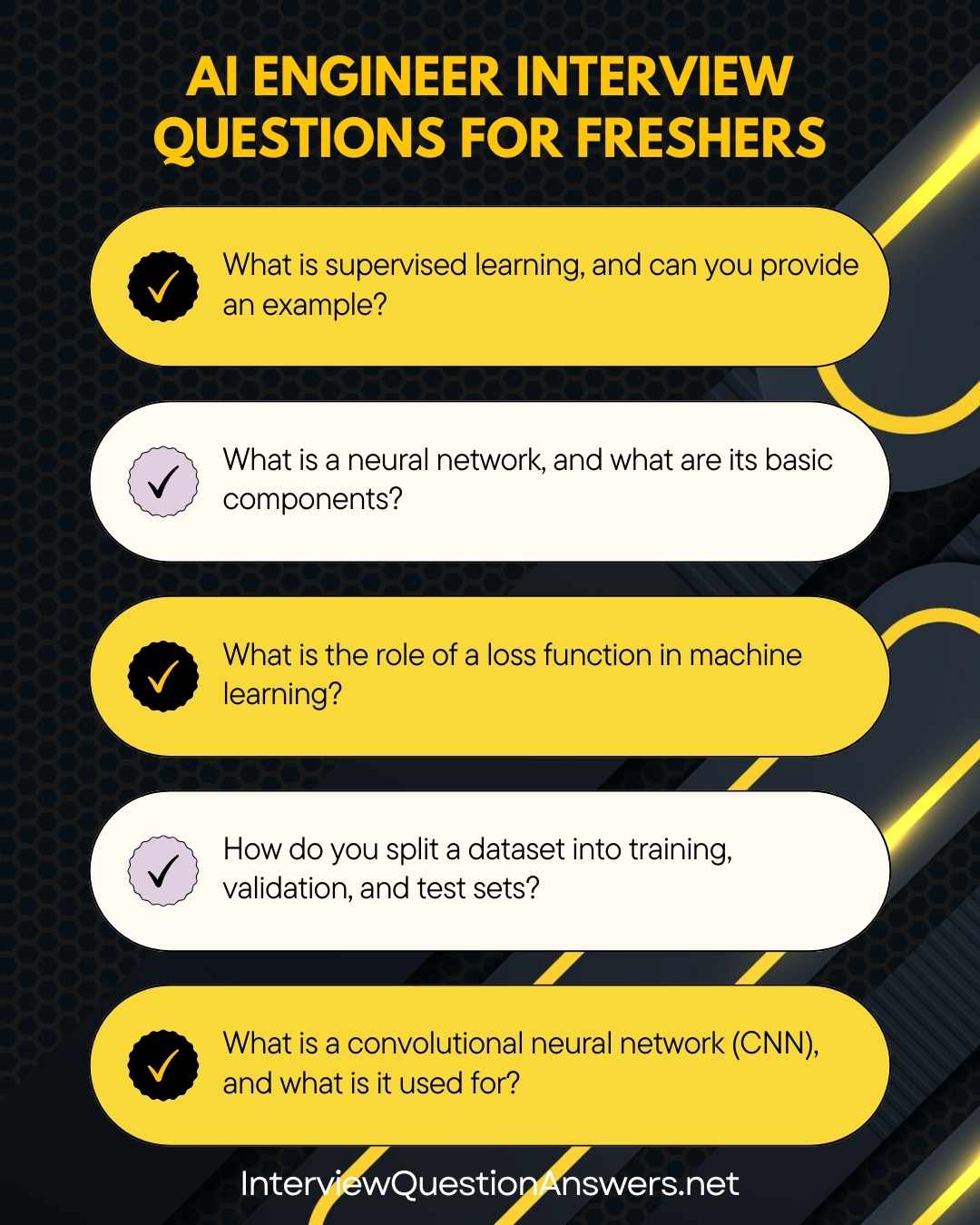
Also Check: Most Common AI Engineer Interview Questions for Experienced
Advanced Artificial intelligence Interview Questions and Answers for Freshers
Que 26. What is the difference between L1 and L2 regularization, and how do they impact model training?
Answer: L1 regularization (Lasso) adds the absolute value of weights to the loss function, promoting sparsity by driving some weights to zero, which aids feature selection. L2 regularization (Ridge) adds the squared value of weights, reducing large weights to prevent overfitting without eliminating features. L1 is computationally intensive but effective for sparse models, while L2 is smoother and better for correlated features. For freshers in 2025, understanding their implementation in frameworks like TensorFlow (e.g., kernel_regularizer) and their effect on gradient descent optimization is crucial for building robust models.
Example:
import tensorflow as tf
model = tf.keras.Sequential([
    tf.keras.layers.Dense(64, kernel_regularizer=tf.keras.regularizers.l2(0.01))
])
Que 27. How does a Convolutional Neural Network (CNN) differ from a fully connected neural network?
Answer: A CNN uses convolutional layers to extract spatial features (e.g., edges in images) through kernels, leveraging parameter sharing and local connectivity to reduce parameters, making it efficient for grid-like data. A fully connected neural network connects every neuron across layers, requiring more parameters and ignoring spatial relationships, suitable for tabular data. For freshers, CNNs are preferred for image or time-series tasks due to their ability to handle high-dimensional inputs efficiently, while fully connected networks are prone to overfitting in such cases.
Que 28. What is the vanishing gradient problem, and how can it be mitigated?
Answer: The vanishing gradient problem occurs when gradients in deep neural networks become too small during backpropagation, slowing or stopping learning in early layers. Mitigate it using:
- ReLU activation to avoid gradient saturation.
- Batch normalization to stabilize training.
- Advanced architectures like LSTMs or ResNets with skip connections.
For freshers in 2025, understanding gradient clipping and using frameworks like PyTorch to monitor gradients during training are practical solutions.
Que 29. How do you implement a basic Recurrent Neural Network (RNN) in Python?
Answer: RNNs process sequential data by maintaining hidden states across time steps. Implement using TensorFlow or PyTorch for tasks like time-series prediction.
Example:
import tensorflow as tf
model = tf.keras.Sequential([
    tf.keras.layers.SimpleRNN(50, input_shape=(timesteps, features)),
    tf.keras.layers.Dense(1)
])
model.compile(optimizer='adam', loss='mse')
For freshers, understanding RNN’s limitations (e.g., vanishing gradients) and exploring LSTMs for longer sequences is key.
Que 30. What is the role of batch normalization in deep learning?
Answer: Batch normalization normalizes layer inputs across mini-batches, reducing internal covariate shift and stabilizing training. It accelerates convergence, reduces sensitivity to initialization, and allows higher learning rates. For freshers in 2025, implementing it in TensorFlow (BatchNormalization layer) and understanding its placement before or after activation functions enhances model performance.
Que 31. What is transfer learning, and how is it applied in AI projects?
Answer: Transfer learning reuses a pre-trained model (e.g., VGG16, BERT) on a new task, fine-tuning layers to adapt to specific data. It’s used in image classification or NLP when data is limited, saving training time. For freshers, fine-tuning pre-trained models from TensorFlow Hub or Hugging Face, freezing lower layers, and training task-specific layers is a common approach.
Example:
from tensorflow.keras.applications import VGG16
base_model = VGG16(weights='imagenet', include_top=False)
Que 32. How do you handle class imbalance in classification tasks?
Answer: Class imbalance occurs when classes have unequal representation. Handle with:
- Oversampling (e.g., SMOTE).
- Class weights in loss functions.
- Data augmentation for minority classes.
For freshers in 2025, using scikit-learn’sclass_weightparameter in models like LogisticRegression or evaluating with F1-score/AUC-ROC ensures robust performance.
Example:
from sklearn.ensemble import RandomForestClassifier
model = RandomForestClassifier(class_weight='balanced')
Que 33. What is the purpose of dropout in neural networks?
Answer: Dropout randomly deactivates a fraction of neurons during training to prevent overfitting by reducing co-dependency among neurons. It acts as an ensemble method, improving generalization. For freshers, applying dropout in TensorFlow (Dropout layer) with rates like 0.2–0.5 is standard for deep networks.
Example:
import tensorflow as tf
model = tf.keras.Sequential([tf.keras.layers.Dropout(0.3)])
Que 34. How do you evaluate a deep learning model’s performance?
Answer: Evaluate using:
- Classification: Accuracy, F1-score, AUC-ROC.
- Regression: MSE, RMSE, MAE.
Use validation sets, cross-validation, and confusion matrices. For freshers in 2025, visualizing metrics with TensorBoard or plotting ROC curves with scikit-learn provides insights into model behavior.
Que 35. What is the difference between a generative and discriminative model?
Answer: Generative models (e.g., Naive Bayes, GANs) learn the joint probability distribution P(X, Y) to generate data. Discriminative models (e.g., SVM, logistic regression) learn the conditional probability P(Y|X) for classification. For freshers, generative models are useful for data synthesis, while discriminative models excel in prediction tasks.
Que 36. How do you implement a basic logistic regression model for binary classification?
Answer: Logistic regression predicts probabilities using a sigmoid function. Implement with scikit-learn for binary classification tasks.
Example:
from sklearn.linear_model import LogisticRegression
model = LogisticRegression()
model.fit(X_train, y_train)
predictions = model.predict_proba(X_test)
For freshers, tuning hyperparameters like C (inverse regularization strength) is key.
Que 37. What is the role of an optimizer in training neural networks?
Answer: An optimizer updates model weights to minimize the loss function using algorithms like SGD, Adam, or RMSprop. Adam combines momentum and adaptive learning rates for faster convergence. For freshers in 2025, understanding learning rate schedules in PyTorch enhances training efficiency.
Que 38. How do you preprocess text data for natural language processing (NLP) tasks?
Answer: Preprocess text by:
- Tokenizing (splitting into words).
- Removing stop words.
- Applying stemming/lemmatization.
- Vectorizing (e.g., TF-IDF, word embeddings).
For freshers, using NLTK or spaCy for tokenization and Hugging Face for embeddings is standard.
Example:
from sklearn.feature_extraction.text import TfidfVectorizer
vectorizer = TfidfVectorizer()
X = vectorizer.fit_transform(['text one', 'text two'])
Que 39. What is the difference between k-means clustering and hierarchical clustering?
Answer: K-means partitions data into k clusters by minimizing variance, requiring predefined k. Hierarchical clustering builds a tree of clusters (dendrogram) without needing k, either bottom-up (agglomerative) or top-down (divisive). For freshers, k-means is faster, but hierarchical is better for complex structures.
Que 40. How do you implement a basic feedforward neural network in Python?
Answer: A feedforward neural network passes data through layers without cycles. Implement using TensorFlow or PyTorch.
Example:
import tensorflow as tf
model = tf.keras.Sequential([
    tf.keras.layers.Dense(64, activation='relu', input_shape=(features,)),
    tf.keras.layers.Dense(1, activation='sigmoid')
])
model.compile(optimizer='adam', loss='binary_crossentropy')
Que 41. What is the purpose of hyperparameter tuning in AI models?
Answer: Hyperparameter tuning optimizes model settings (e.g., learning rate, number of layers) to improve performance. Use grid search, random search, or Bayesian optimization. For freshers in 2025, tools like Optuna simplify tuning.
Que 42. How do you handle overfitting in deep learning models?
Answer: Prevent overfitting with:
- Regularization (L1/L2, dropout).
- Data augmentation.
- Early stopping based on validation loss.
For freshers, monitoring training/validation curves in TensorBoard helps detect overfitting early.
Que 43. What is the difference between precision, recall, and F1-score?
Answer: Precision is the ratio of true positives to predicted positives; recall is the ratio of true positives to actual positives; F1-score is their harmonic mean, balancing both. For freshers, using scikit-learn’s classification_report evaluates these metrics.
Que 44. How do you implement data augmentation for image data?
Answer: Data augmentation applies transformations (e.g., rotation, flipping) to increase training data. Use libraries like TensorFlow’s ImageDataGenerator.
Example:
from tensorflow.keras.preprocessing.image import ImageDataGenerator
datagen = ImageDataGenerator(rotation_range=20, horizontal_flip=True)
datagen.fit(images)
Que 45. What is the role of word embeddings in NLP?
Answer: Word embeddings (e.g., Word2Vec, GloVe) represent words as dense vectors capturing semantic relationships. They improve NLP tasks like sentiment analysis by encoding context. For freshers, using pre-trained embeddings from Hugging Face is common.
Que 46. How do you implement a basic decision tree model in Python?
Answer: Decision trees split data based on feature thresholds for classification or regression.
Example:
from sklearn.tree import DecisionTreeClassifier
model = DecisionTreeClassifier(max_depth=5)
model.fit(X_train, y_train)
For freshers, pruning trees (e.g., setting max_depth) prevents overfitting.
Que 47. What is the difference between a shallow and deep neural network?
Answer: Shallow networks have few hidden layers, suitable for simple tasks. Deep networks have many layers, capturing complex patterns for tasks like image recognition. For freshers, deep networks require more data and computational resources.
Que 48. How do you evaluate a clustering model’s performance?
Answer: Use internal metrics like Silhouette Score (measures cluster cohesion/separation) or Davies-Bouldin Index. For freshers in 2025, visualizing clusters with PCA or t-SNE in matplotlib aids interpretation.
Que 49. What is the purpose of a learning rate in neural network training?
Answer: The learning rate controls the step size in gradient descent, affecting convergence speed and stability. Too high causes instability; too low slows training. For freshers, tuning with schedules (e.g., ReduceLROnPlateau in TensorFlow) optimizes performance.
Que 50. How do you visualize a neural network’s architecture in Python?
Answer: Visualize using tools like TensorFlow’s plot_model or libraries like Netron for model graphs.
Example:
from tensorflow.keras.utils import plot_model
plot_model(model, to_file='model.png', show_shapes=True)
For freshers, this helps debug and communicate model structure to stakeholders.
Conclusion
We have already shared the essential questions for AI Engineer Interview Questions and Answers for Freshers. This comprehensive AI Engineer Guide includes interview questions and answers for fresh graduates, covering both basic and advanced concepts that employers commonly evaluate. The artificial intelligence engineering industry is rapidly evolving with generative AI, transformer models, and AI ethics becoming standard requirements for entry-level positions.
These Artificial intelligence Engineer Interview Questions and Answers for Freshers provide the technical foundation needed to succeed in your job search, covering neural networks to AI application development. With proper preparation using these AI Engineer Interview Questions and Answers for Freshers and understanding current industry demands, you’ll be well-positioned to launch your artificial intelligence engineering career.
Related Interview Guides: