
Most Common AI Engineer Interview Questions for Experienced
AI Engineer Interview Questions for Experienced professionals focus on advanced AI system architecture, model optimization, and technical leadership that practitioners with industry experience must demonstrate. Since artificial intelligence engineering is a relatively new field, even 1-2 years of experience matters significantly in this rapidly evolving landscape.
Here we have Artificial Intelligence Interview Questions for Experienced candidates who have worked with production AI systems, addressing complex neural architectures, AI infrastructure design, and cross-functional collaboration scenarios. These AI Engineer Interview Questions for Experienced professionals will help you showcase your expertise, demonstrate measurable AI system improvements, and prove your readiness for senior roles in today’s competitive artificial intelligence market.
You can also check our main interview guide here: AI Engineer Interview Questions with PDF
Table of Contents
AI Engineer Interview Questions for 1 Year Experience
Que. 1 What is the difference between Artificial Intelligence, Machine Learning, and Deep Learning, and provide examples of each?
Answer:
Artificial Intelligence (AI) is the broad field of creating machines that mimic human intelligence, encompassing rule-based systems to advanced learning. Machine Learning (ML) is a subset of AI where models learn patterns from data without explicit programming, like predicting house prices using regression. Deep Learning (DL) is a subset of ML using neural networks with multiple layers to handle complex data, such as image recognition with CNNs.
Examples: AI – Virtual assistants like Siri; ML – Spam email filters using Naive Bayes; DL – Facial recognition in photos via deep neural nets. For junior engineers, understanding this hierarchy helps in choosing the right approach for tasks, as DL requires more data and compute than traditional ML.
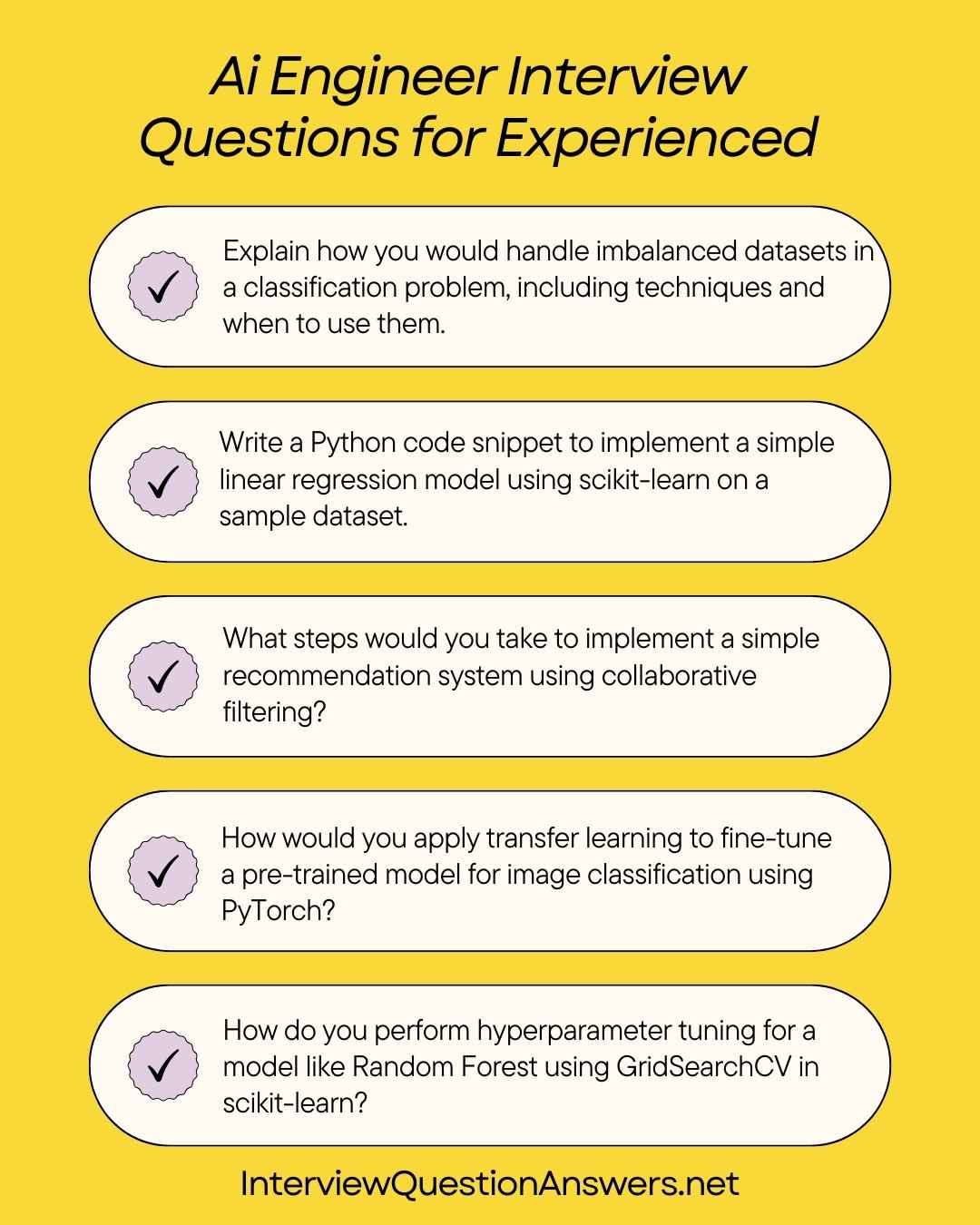
Que. 2 Explain how you would handle imbalanced datasets in a classification problem, including techniques and when to use them.
Answer:
Imbalanced datasets occur when classes have unequal samples, like fraud detection where fraud is rare. Techniques include oversampling the minority class (e.g., SMOTE to create synthetic samples), undersampling the majority (random removal, but risks data loss), or class weighting in models to penalize misclassifying minorities.
Use SMOTE for small datasets to avoid overfitting, undersampling for large ones to reduce compute. Evaluate with F1-score or AUC-PR instead of accuracy. In Python with scikit-learn:
from imblearn.over_sampling import SMOTE
from sklearn.model_selection import train_test_split

X_train, X_test, y_train, y_test = train_test_split(X, y, test_size=0.2)
smote = SMOTE()
X_resampled, y_resampled = smote.fit_resample(X_train, y_train)
This balances classes, improving model recall on minorities.
Que. 3 How would you preprocess data for a machine learning model, including steps for handling missing values, scaling, and encoding categorical variables?
Answer:
Preprocessing ensures data quality for ML models. Steps: Handle missing values by imputation (mean/median for numerics, mode for categoricals) or dropping if <5% affected. Scale features using StandardScaler for normal distribution or MinMaxScaler for bounded ranges. Encode categoricals with OneHotEncoder for nominal or OrdinalEncoder for ordered.
In practice, for a dataset with NaNs and categories:
import pandas as pd
from sklearn.preprocessing import StandardScaler, OneHotEncoder
from sklearn.impute import SimpleImputer

df = pd.read_csv('data.csv')
imputer = SimpleImputer(strategy='mean')
df[num_cols] = imputer.fit_transform(df[num_cols])
encoder = OneHotEncoder(sparse_output=False)
encoded = encoder.fit_transform(df[cat_cols])
scaler = StandardScaler()
df[num_cols] = scaler.fit_transform(df[num_cols])
This prepares clean, normalized data, preventing issues like skewed gradients in training.
Que. 4 Write a Python code snippet to implement a simple linear regression model using scikit-learn on a sample dataset.
Answer:
Linear regression predicts continuous outcomes. Use scikit-learn for implementation:
import numpy as np
from sklearn.linear_model import LinearRegression
from sklearn.model_selection import train_test_split
from sklearn.metrics import mean_squared_error

# Sample data: House size (X) vs price (y)
X = np.array([[500], [750], [1000], [1250], [1500]])
y = np.array([100000, 150000, 200000, 250000, 300000])

X_train, X_test, y_train, y_test = train_test_split(X, y, test_size=0.2)
model = LinearRegression()
model.fit(X_train, y_train)
predictions = model.predict(X_test)
mse = mean_squared_error(y_test, predictions)
print(f'MSE: {mse}')
Evaluate with MSE; lower values indicate better fit. For 1-2 years experience, focus on interpreting coefficients (slope as price per sq ft).
Que. 5 How do you detect and mitigate overfitting in a machine learning model during training?
Answer:
Overfitting happens when a model learns noise instead of patterns, performing well on training but poorly on test data. Detect via high training accuracy but low validation accuracy, or learning curves showing divergence.
Mitigate with cross-validation (k-fold to average performance), regularization (L1/L2 in regression), dropout in neural nets, or early stopping. Prune trees in decision models. Use simpler models if data is limited.
In practice, monitor validation loss; stop if it rises while training loss falls. This ensures generalization, crucial for real-world deployment.
Que. 6 Explain the bias-variance tradeoff and how it affects model selection.
Answer:
Bias-variance tradeoff balances underfitting (high bias, simple models missing patterns) and overfitting (high variance, complex models capturing noise). Optimal models minimize total error (bias^2 + variance + noise).
High bias: Use more features or complex models. High variance: Add data, regularize, or ensemble. Select via validation curves: Plot error vs complexity; choose the sweet spot.
For juniors, this guides choosing linear regression (low variance) for simple data vs neural nets (higher variance but lower bias) for complex tasks.
Que. 7 Write a Python code snippet using TensorFlow to build and train a basic neural network for binary classification on the Iris dataset (use only two classes).
Answer:
Use TensorFlow for neural nets:
import tensorflow as tf
from sklearn.datasets import load_iris
from sklearn.model_selection import train_test_split
from sklearn.preprocessing import StandardScaler

iris = load_iris()
X = iris.data[iris.target != 2]  # Binary: classes 0 and 1
y = iris.target[iris.target != 2]
X_train, X_test, y_train, y_test = train_test_split(X, y, test_size=0.2)
scaler = StandardScaler().fit(X_train)
X_train = scaler.transform(X_train)
X_test = scaler.transform(X_test)

model = tf.keras.Sequential([
    tf.keras.layers.Dense(16, activation='relu', input_shape=(4,)),
    tf.keras.layers.Dense(1, activation='sigmoid')
])
model.compile(optimizer='adam', loss='binary_crossentropy', metrics=['accuracy'])
model.fit(X_train, y_train, epochs=50, validation_split=0.2)
loss, acc = model.evaluate(X_test, y_test)
print(f'Accuracy: {acc}')
This classifies setosa vs versicolor; sigmoid for binary output.
Que. 8 How would you evaluate a regression model, including key metrics and when to use each?
Answer:
Evaluate regression with metrics like Mean Absolute Error (MAE) for average error magnitude (robust to outliers), Mean Squared Error (MSE) to penalize large errors (sensitive to outliers), Root MSE (RMSE) for error in original units, and R-squared for explained variance (0-1 scale).
Use MAE for interpretable errors (e.g., predicting sales), RMSE when large errors matter (e.g., medical doses). Plot residuals for patterns; uniform scatter indicates good fit. Cross-validate to avoid overfitting.
Que. 9 What steps would you take to implement a simple recommendation system using collaborative filtering?
Answer:
Collaborative filtering recommends based on user similarities. Steps: Collect user-item ratings matrix. Compute similarities (e.g., cosine) between users/items. Predict ratings for unseen items via weighted averages. Recommend top predicted.
Use surprise library in Python:
from surprise import Dataset, SVD, accuracy
from surprise.model_selection import train_test_split

data = Dataset.load_builtin('ml-100k')
trainset, testset = train_test_split(data, test_size=0.2)
model = SVD()
model.fit(trainset)
predictions = model.test(testset)
rmse = accuracy.rmse(predictions)
Handle cold-start with content-based hybrids. For juniors, focus on matrix sparsity issues.
Que. 10 Explain tokenization in NLP and implement a simple tokenizer in Python for a given sentence.
Answer:
Tokenization splits text into tokens (words/subwords) for processing. Types: Word (space-split), subword (BPE for OOV words).
Simple implementation:
import re

def tokenize(text):
    text = re.sub(r'[^\w\s]', '', text.lower())  # Remove punctuation, lowercase
    tokens = text.split()  # Word-level
    return tokens

sentence = "Hello, world! This is AI."
print(tokenize(sentence))  # ['hello', 'world', 'this', 'is', 'ai']
Use NLTK or HuggingFace for advanced. Essential for feeding text to models like BERT.
Also Check: Artificial intelligence Engineer Interview Questions for Freshers
AI Engineer Interview Questions for 2 Year Experience
Que. 11 How would you apply transfer learning to fine-tune a pre-trained model for image classification using PyTorch?
Answer:
Transfer learning uses pre-trained weights (e.g., ResNet) and fine-tunes on new data. Freeze base layers, replace classifier.
In PyTorch:
import torch
import torch.nn as nn
from torchvision import models
from torch.utils.data import DataLoader

model = models.resnet18(pretrained=True)
for param in model.parameters():
    param.requires_grad = False
model.fc = nn.Linear(model.fc.in_features, num_classes)
optimizer = torch.optim.Adam(model.fc.parameters(), lr=0.001)
# Train on DataLoader with your dataset
model.train()
# Loop: loss.backward(), optimizer.step()
This speeds training on small datasets, achieving high accuracy quickly.
Que. 12 What is the attention mechanism in transformers, and why is it important for sequence tasks?
Answer:
Attention computes weighted importance of input parts, allowing models to focus on relevant tokens. Formula: Attention(Q, K, V) = softmax(QK^T / sqrt(d_k)) V, where Q=queries, K=keys, V=values.
Important for sequences as it handles long dependencies better than RNNs, enabling parallelization. In NLP, helps in translation by aligning words. For juniors, it’s key to understanding models like BERT for tasks needing context.
Que. 13 How do you handle categorical features in a dataset for a tree-based model like XGBoost?
Answer:
Tree models like XGBoost handle categoricals via one-hot encoding or native support (enable_categorical=True). One-hot for low cardinality; label encoding risks ordinal assumption.
In code:
import xgboost as xgb
import pandas as pd

df = pd.read_csv('data.csv')
df['category'] = df['category'].astype('category')  # For native handling
dtrain = xgb.DMatrix(df.drop('target', axis=1), label=df['target'], enable_categorical=True)
params = {'objective': 'binary:logistic'}
model = xgb.train(params, dtrain)
Native is efficient; avoids high dimensionality from one-hot.
Que. 14 Write a SQL query to find the top 5 customers by total purchase amount from a sales table with columns: customer_id, purchase_date, amount.
Answer:
Aggregate and rank purchases.
SELECT
    customer_id,
    SUM(amount) AS total_amount
FROM sales
GROUP BY customer_id
ORDER BY total_amount DESC
LIMIT 5;
This identifies high-value customers. Add date filters for time-bound analysis.
Que. 15 How would you deploy a simple ML model as a web service using Flask and scikit-learn?
Answer:
Deployment exposes models via APIs. Train, save, load in Flask.
from flask import Flask, request, jsonify
import joblib
from sklearn.datasets import load_iris
from sklearn.linear_model import LogisticRegression

# Train and save
iris = load_iris()
model = LogisticRegression().fit(iris.data, iris.target)
joblib.dump(model, 'model.pkl')

app = Flask(__name__)
model = joblib.load('model.pkl')

@app.route('/predict', methods=['POST'])
def predict():
    data = request.json['features']
    prediction = model.predict([data])
    return jsonify({'prediction': int(prediction[0])})

if __name__ == '__main__':
    app.run(debug=True)
Access via POST to /predict with JSON features. Use Docker for production.
Que. 16 Explain feature engineering and provide examples for improving a model’s performance.
Answer:
Feature engineering creates/transforms variables to boost model accuracy. Examples: Bin continuous ages into groups (0-18, 19-35), create ratios (income/debt), extract dates (day of week from timestamp).
For text: TF-IDF vectors. Polynomial features for non-linear relations. Improves by capturing hidden patterns, reducing noise. Validate via feature importance plots post-training.
Que. 17 How do you perform hyperparameter tuning for a model like Random Forest using GridSearchCV in scikit-learn?
Answer:
Tuning optimizes parameters like n_estimators, max_depth. Use GridSearchCV for exhaustive search.
from sklearn.ensemble import RandomForestClassifier
from sklearn.model_selection import GridSearchCV
from sklearn.datasets import load_iris

iris = load_iris()
param_grid = {'n_estimators': [50, 100], 'max_depth': [None, 10, 20]}
model = RandomForestClassifier()
grid = GridSearchCV(model, param_grid, cv=5)
grid.fit(iris.data, iris.target)
print(grid.best_params_)
This finds optimal via cross-validation; use RandomizedSearch for larger spaces.
Que. 18 What is cross-validation, and why is it preferred over a single train-test split?
Answer:
Cross-validation splits data into k folds, trains on k-1, tests on 1, averages results. Reduces variance from single split, better estimates generalization.
k=5 or 10 common. Preferred as it uses all data for training/testing, avoiding lucky/unlucky splits. In time-series, use TimeSeriesSplit to preserve order.
Que. 19 How would you implement k-means clustering in Python and determine the optimal number of clusters?
Answer:
K-means groups data into k clusters by minimizing intra-cluster variance.
from sklearn.cluster import KMeans
from sklearn.datasets import make_blobs
import matplotlib.pyplot as plt

X, _ = make_blobs(n_samples=300, centers=4)
inertias = []
for k in range(1, 11):
    kmeans = KMeans(n_clusters=k)
    kmeans.fit(X)
    inertias.append(kmeans.inertia_)
plt.plot(range(1, 11), inertias)
plt.xlabel('Clusters')
plt.ylabel('Inertia')
plt.show()  # Elbow at optimal k
Elbow method finds k where inertia drop slows. Silhouette score alternatives.
Que. 20 Explain the concept of ensemble learning and implement a simple voting classifier in scikit-learn.
Answer:
Ensemble combines multiple models for better predictions, reducing variance (bagging) or bias (boosting). Voting: Majority vote from classifiers.
from sklearn.ensemble import VotingClassifier
from sklearn.linear_model import LogisticRegression
from sklearn.tree import DecisionTreeClassifier
from sklearn.svm import SVC
from sklearn.datasets import load_iris

iris = load_iris()
clf1 = LogisticRegression()
clf2 = DecisionTreeClassifier()
clf3 = SVC()
ensemble = VotingClassifier(estimators=[('lr', clf1), ('dt', clf2), ('svc', clf3)], voting='hard')
ensemble.fit(iris.data, iris.target)
Improves robustness; soft voting uses probabilities for weighted decisions.
Also Check: Python Interview Questions for Experienced
Artificial Intelligence Engineer Interview Questions for 3 Year Experience
Que. 21 How do you detect outliers in a dataset and handle them for a regression task?
Answer:
Detect outliers via Z-score (>3 std devs), IQR (beyond 1.5*IQR), or visuals (boxplots). Handle: Remove if errors, cap/winsorize, or use robust models like RANSAC.
In pandas:
import pandas as pd
import numpy as np

df = pd.DataFrame({'value': np.random.normal(0, 1, 100)})
df.loc[0] = 10  # Outlier
z_scores = np.abs((df - df.mean()) / df.std())
outliers = df[z_scores > 3]
df_clean = df[z_scores <= 3]  # Remove
For regression, outliers skew lines; handling prevents bias.
Que. 22 What is dimensionality reduction, and implement PCA on a sample dataset using scikit-learn.
Answer:
Dimensionality reduction reduces features while retaining info, combating curse of dimensionality. PCA finds principal components maximizing variance.
from sklearn.decomposition import PCA
from sklearn.datasets import load_iris

iris = load_iris()
pca = PCA(n_components=2)
X_reduced = pca.fit_transform(iris.data)
print(pca.explained_variance_ratio_)  # Variance retained
Use for visualization or speeding models; check cumulative variance >80%.
Que. 23 How would you build a basic sentiment analysis model using NLTK in Python?
Answer:
Sentiment analysis classifies text as positive/negative. Use VADER for rule-based.
import nltk
from nltk.sentiment.vader import SentimentIntensityAnalyzer

nltk.download('vader_lexicon')
sia = SentimentIntensityAnalyzer()
text = "This is great!"
scores = sia.polarity_scores(text)
print(scores['compound'])  # >0 positive
For ML, vectorize with TF-IDF, train classifier. Handles social media reviews.
Que. 24 Explain A/B testing in the context of ML model deployment and why it’s important.
Answer:
A/B testing compares model versions (A: old, B: new) on user subsets, measuring metrics like conversion rate. Random split ensures fairness; statistical tests (t-test) check significance.
Important for validating improvements without full rollout risks. Use tools like Optimizely. For juniors, it ensures data-driven decisions, avoiding deployment failures.
Que. 25 How do you optimize a neural network’s training process to reduce computation time?
Answer:
Optimize with batch training (mini-batches for faster convergence), early stopping (halt if validation stalls), reduce layers/neurons, use GPU (CUDA in PyTorch), or mixed-precision (FP16).
Monitor with learning rate schedulers. For large data, sample subsets. Balances speed and accuracy.
Que. 26 Write a Python function to compute confusion matrix and derive precision, recall from it for a binary classifier.
Answer:
Confusion matrix shows TP, FP, TN, FN.
from sklearn.metrics import confusion_matrix

def metrics(y_true, y_pred):
    cm = confusion_matrix(y_true, y_pred)
    tp, fp, fn, tn = cm.ravel()
    precision = tp / (tp + fp) if (tp + fp) > 0 else 0
    recall = tp / (tp + fn) if (tp + fn) > 0 else 0
    return precision, recall

# Usage: precision, recall = metrics([0,1,0,1], [0,1,1,1])
Precision minimizes FP; recall minimizes FN. Key for imbalanced tasks.
Que. 27 How would you use scikit-learn to build and evaluate a decision tree classifier?
Answer:
Decision trees split data on features for classification.
from sklearn.tree import DecisionTreeClassifier
from sklearn.datasets import load_iris
from sklearn.model_selection import train_test_split
from sklearn.metrics import accuracy_score

iris = load_iris()
X_train, X_test, y_train, y_test = train_test_split(iris.data, iris.target, test_size=0.2)
model = DecisionTreeClassifier(max_depth=3)
model.fit(X_train, y_train)
preds = model.predict(X_test)
print(accuracy_score(y_test, preds))
Tune depth to avoid overfitting; visualize tree for interpretability.
Que. 28 What is Reinforcement Learning, and describe a simple scenario where it could be applied.
Answer:
Reinforcement Learning (RL) trains agents via rewards/punishments in environments, using policies to maximize cumulative rewards. Components: State, action, reward.
Scenario: Game AI like Tic-Tac-Toe, where agent learns moves (actions) from wins (rewards). Q-learning updates values. For juniors, it’s for dynamic decisions, unlike supervised ML.
Que. 29 How do you ensure ethical considerations in AI model development, such as addressing bias?
Answer:
Ethical AI avoids harm; address bias by diverse training data, auditing (fairness metrics like disparate impact), debiasing (reweighting samples). Use explainable models (SHAP).
Document processes for transparency. In hiring models, remove gender proxies. Important for compliance (GDPR) and trust.
Que. 30 Explain Retrieval-Augmented Generation (RAG) and its advantages over standard LLMs.
Answer:
RAG enhances LLMs by retrieving relevant documents from a knowledge base (e.g., vector DB like FAISS) and augmenting prompts, reducing hallucinations.
Advantages: Up-to-date info without retraining, cost-effective. Implement: Embed queries/docs, retrieve top-k, generate. For juniors, it’s practical for chatbots needing external facts.
Conclusion
We have already shared the essential questions for AI Engineer Interview Questions for Experienced professionals. This comprehensive AI Engineer Guide includes interview questions for experienced candidates, covering advanced technical scenarios and leadership challenges that employers evaluate. With proper preparation using these Artificial Intelligence Interview Questions and understanding current industry demands, you’ll be well-positioned to secure senior artificial intelligence engineering positions.
Related Interview Guides: